
New Year, New Us
A science-backed reflection on why we don’t flourish alone and what it means to begin again together

Every January, we are handed the same script.
New year, new you.
New habits. New goals. New versions of ourselves we want to become.
Although most of us act with the best of intentions, there is something both hopeful and exhausting about that story. For many people, it starts to feel like Groundhog Day: resolutions are made with sincerity and then slowly slip away. It frames change as a solo project, a private campaign of discipline and self-improvement, as if we transform by willpower alone. But that is not how human beings actually flourish.
There may be rare exceptions, but for most of us, we do not get well alone. We do not become ourselves alone. And we do not sustain change alone.
Some of the most compelling thinking in wellbeing now points to something both simple and radical. How we are doing is deeply shaped by how we are doing together. Not just me, but us. Our relationships, neighborhoods, shared spaces, and sense of belonging.
The World Health Organization’s 2025 report makes something clear. Social connection - from meaningful friendships to everyday neighborhood ties - is a key determinant of good health. Strong social connections are associated with better health outcomes and lower risk of premature death, while loneliness and isolation are linked to serious physical and mental health harms.
We see the same pattern in research about addiction: Robust support networks, such as family, close friendships, and community ties, act as protective factors against developing substance use disorders. Youth who feel connected to their schools and families have lower rates of misuse. These experiences shape brain development and how we regulate stress, not just behavior. (Watch Johann Hari’s popular TED Talk, “Everything you think you know about addiction is wrong ...”)
We live in a culture that has become exquisitely good at personal optimization. We track our steps, our sleep, our mood, our calories. We meditate. We journal. We download apps designed to make us calmer, happier, and more productive. We even curate our entertainment into separate algorithmic silos inside our own homes.
And yet even the most dedicated self-care routine cannot replace the feeling of being part of something larger. The experience of being seen, needed, and woven into the life around you.
Celebrating a family member’s victory, even when it feels small. A friend who checked in on you at exactly the right moment. The neighbor who shoveled your driveway without being asked. The neighborhood or group that made you feel like you belonged - be it a book club, an exercise class, or friendly grocery store check-out clerk.
The World Happiness Report 2025 finds that people who experience higher levels of trust, kindness, and everyday social connection consistently report greater well-being across cultures. That includes sharing meals, helping others, and feeling supported by the people around them.
And as extreme longevity becomes a growing cultural preoccupation, it is worth remembering that dozens of supplements and endless optimization may not be the most powerful medicine of all. Deep, sustained social bonds can slow biological aging, literally shaping our bodies over time in ways that reflect how connected we are to others.
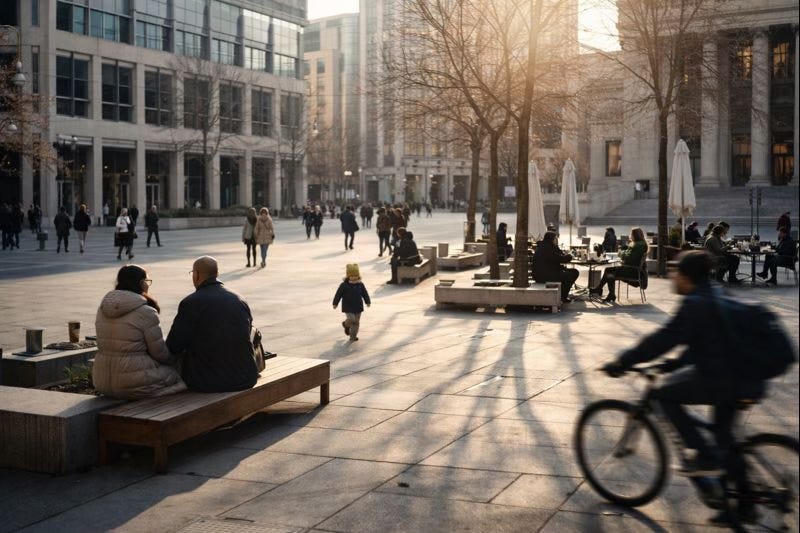
We talk constantly about what I should do, how I should improve, heal, and grow. But we talk far less about the environments we live in. Whether our streets feel welcoming. Whether our public spaces invite connection. Whether our communities make it easier to care for one another.
Yet these things can matter just as much as what we eat or how often we meditate.
They shape whether we feel safe.
Whether we trust one another.
Whether we have places to gather, to rest, to create, to grieve, and to celebrate.
In other words, they shape whether we can truly thrive.
These ideas have been especially present for me after conversations with Anna Alexandrova, Professor of Philosophy of Science at the University of Cambridge, public policy scholar Mark Fabian, and other scholars who study how communities flourish. They are asking a deceptively simple question. Not just how individuals are doing, but how our shared spaces, institutions, and relationships support or undermine our ability to live well together.
I explored this work more deeply in a story for the John Templeton Foundation, No Man Is an Island: Well-Being as a Collective Endeavor, which looks at how well-being is increasingly understood as something built through trust, beauty, public spaces, and everyday acts of care. If you would like to go deeper into that research, you can find it here.
But even without the data, most of us know this intuitively. We feel better when our world feels kinder. When we have somewhere to go. When someone notices if we do not show up.
So perhaps this year does not need to be only about becoming a newer, shinier version of yourself.
Perhaps it can be about something less lonely and less solitary.
New year, new us.
What would it look like to invest not only in your own well-being, but in the well-being of the places and people around you?
To thank someone who made your life better, no matter how small the moment.
To support a space that brings people together.
To create a little more beauty, safety, or generosity wherever you live.
How we are doing is not defined only by how productive or disciplined we feel. It is shaped by whether we are safely and positively connected to the world we are part of, and whether we are a safe and welcoming place for others to connect as well.
You’re always welcome here. If this resonated, I write each week about the science, culture, and lived experience of what it means to thrive. You can subscribe below to keep reading.